
Indian Wedding Traditions Explained: A Simple Guide for Couples and Their Guests
If you have ever been invited to an Indian wedding and wondered what is actually happening during each ceremony, you are not alone.
And if you are an NRI couple planning your own wedding, you might be in the slightly funny position of wanting to honour traditions you grew up watching but never had fully explained to you. Or perhaps your partner or international guests have no frame of reference at all.
Either way, this guide is for you. No jargon, no overwhelming detail. Just a clear, friendly explanation of Indian wedding traditions and what they actually mean.
Why Indian Wedding Traditions Matter
An Indian wedding is not just a party. Every ritual has a meaning, a history, and a reason it has been passed down through generations.
For NRI couples, these traditions are often the most emotional part of the whole celebration. They are a connection to family, culture, and roots that can feel even more meaningful when you have spent years living far from home.
For guests who are new to Indian wedding traditions, understanding what is happening transforms the experience entirely. Instead of watching from the outside, they are participating. And that makes every moment feel more special for everyone in the room.
The Pre-Wedding Ceremonies
Roka or Engagement
The official start of everything.
The families come together formally, gifts are exchanged, and the couple is blessed. It sets the tone for the celebrations ahead and marks the moment the wedding journey officially begins.
Mehendi
One of the most beloved of all Indian wedding traditions.
The bride’s hands and feet are decorated with intricate henna patterns, often containing the hidden initials of the groom for him to find later. It is a relaxed, joyful gathering, usually with music, dancing, and food, and it brings the women of both families together before the wedding day.
Haldi
Turmeric paste is applied to the bride and groom by family members in separate ceremonies.
It is believed to bless the couple, bring good luck, and give the skin a natural glow before the wedding. Usually just close family present, it is one of the most intimate and emotional of all the pre-wedding rituals.
Sangeet
Translated literally, sangeet means music. And that is exactly what it is.
An evening of performances, dancing, and celebration where families often prepare choreographed dances to surprise the couple. The whole evening has the energy of a party that doubles as a heartfelt tribute.
According to Brides magazine, the sangeet has grown into one of the most anticipated events of the Indian wedding weekend, particularly among younger couples who want a night that feels personal and celebratory in equal measure.
The Wedding Day Ceremonies
Baraat
The groom’s arrival procession.
He travels to the wedding venue accompanied by family and friends, often on a decorated horse or in a grand car, with a dhol band playing and everyone dancing around him. It is loud, joyful, and completely infectious. Even guests who have never seen one before tend to end up dancing within minutes.
Milni
The formal greeting between the two families just before the ceremony begins.
The bride’s family welcomes the groom’s family with garlands and blessings. It is a beautiful and often emotional moment that marks the two families coming together as one.
Jaimala or Varmala
The exchange of flower garlands between the bride and groom.
In many weddings it becomes a playful tug of war as the families on each side try to lift their person higher so the other cannot reach. It always gets a laugh, and it is a lovely moment of lightness before the ceremony begins.
Pheras
The heart of Indian wedding traditions.
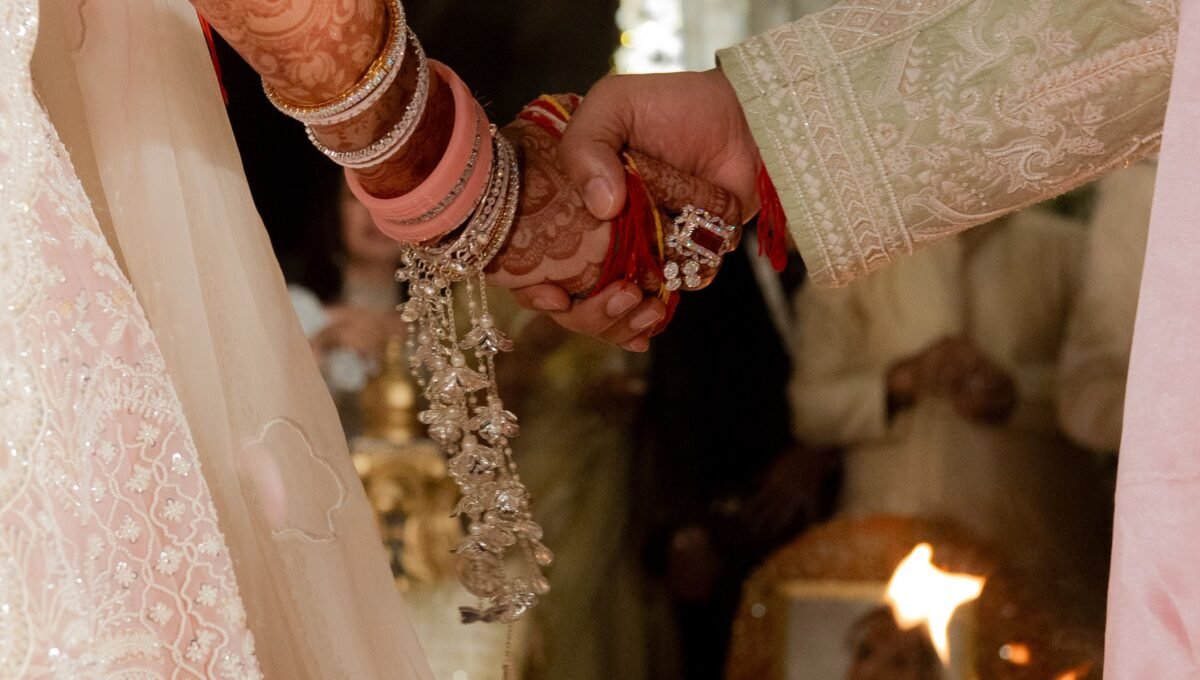
The couple takes seven rounds around the sacred fire, known as the Saat Phere, each round representing a vow. Together they promise each other prosperity, good health, loyalty, family, children, lifelong friendship, and spiritual union.
These seven rounds are the moment the couple is considered truly married. For most guests, this is the most moving part of the entire day.
Sindoor and Mangalsutra
After the pheras, the groom applies sindoor, a red powder, to the parting of the bride’s hair, and places the mangalsutra, a sacred necklace, around her neck.
Both are symbols of marriage the bride will wear from this day forward. It is a quiet, intimate moment that carries enormous weight.
Vidaai
The farewell. The bride leaves her family home for the last time as an unmarried woman.
She throws rice back over her shoulder as she walks away, a symbol of returning prosperity to her family. It is one of the most emotional moments of any traditional wedding India ceremony, and it is rare to find a dry eye in the room.
Tips for International Guests
If you are attending an Indian wedding for the first time, here are a few things worth knowing:
● Dress to impress. Indian weddings are an occasion to wear colour. Bright, festive outfits are warmly welcomed. Avoid white and black, as these are traditionally associated with mourning.
● Arrive with flexibility. Things may start later than listed and run longer than expected. That is part of the experience, not a problem.
● Participate where you can. Whether it is joining the dancing at the sangeet or clapping during the baraat, guests who join in are always appreciated.
● Ask questions. Nobody expects international guests to know every ritual. Asking what is happening is always welcome and usually leads to lovely conversations.
● Expect to be fed. A lot. Indian weddings are famous for their food, and saying no is rarely accepted gracefully.
How Turquoise Weddings Brings It All Together
Understanding Indian wedding traditions is one thing.
Making sure every single one of them is executed beautifully, in the right order, with the right vendors and the right timing, is another entirely.
At Turquoise Weddings, we work with NRI couples who want their traditional wedding India celebration to feel authentic and seamless. Whether that means coordinating the right priest for the pheras, briefing the mehendi artist on the bride’s preferences, or making sure international guests have a simple guide to what is happening and when, every detail is taken care of.
As an experienced Indian wedding planner working with couples across the US, UK, and Canada, we bring the cultural knowledge and on the ground experience to make every tradition feel as special as it deserves to be.
Final Thoughts
Every tradition in an Indian wedding exists for a reason.
And when you understand what is happening, whether you are the couple at the centre of it or a guest witnessing it for the first time, the whole experience shifts. The moments feel heavier, the emotions feel closer, and the memories stick differently.
That is the real value of these traditions. Not the rituals themselves, but what they create in the room.
FAQs
1. What is the order of ceremonies at an Indian wedding?
It typically starts with pre-wedding functions, mehendi, haldi, and sangeet, followed by the baraat, milni, jaimala, pheras, sindoor, mangalsutra, and finally the vidaai. The exact order can vary slightly by region and family tradition, but this is the most common sequence.
2. What is the significance of the pheras at an Indian wedding?
The pheras are the seven rounds the couple takes around the sacred fire, each representing a vow. Prosperity, good health, loyalty, family, children, friendship, and spiritual union. It is the moment the couple is considered truly married in the eyes of tradition.
3. What should international guests wear to an Indian wedding?
Bright, festive colours. Salwar suits, sarees, lehengas, or formal western wear in rich colours all work well. Avoid white and black as both are traditionally associated with mourning in Indian culture.
4. How long does an Indian wedding typically last?
Most Indian weddings span two to three days, with a different function each day. The mehendi and haldi are usually on day one, the sangeet on day two, and the main wedding ceremony and reception on day three.
5. What is the difference between the mehendi and the haldi?
Mehendi is a joyful, social gathering where the bride gets henna applied to her hands and feet. Haldi is more intimate, where turmeric paste is applied to both the bride and groom by close family members as a blessing before the wedding.
6. What happens during the vidaai?
The bride formally leaves her family home after the wedding ceremony. She throws rice back over her shoulder as she walks away, symbolising returning prosperity to her family. It is one of the most emotional moments of any traditional wedding India celebration.
7. Do Indian wedding traditions vary by religion or region?
Yes, quite a bit. Hindu, Sikh, Muslim, and Christian Indian weddings each have their own rituals and customs. Regional traditions also vary, for example a Punjabi wedding feels very different from a South Indian or Bengali one. The ceremonies covered in this guide reflect the most common Hindu North Indian traditions.
8. How can Turquoise Weddings help with planning a traditional Indian wedding?
From coordinating the right priest for the pheras to briefing vendors on each function, Turquoise Weddings manages every detail of Indian wedding traditions on the ground so NRI couples never have to. One point of contact, end to end.
Plan Your Dream Wedding
Let us bring your vision to life with bespoke planning, timeless elegance, and attention to every detail.
Get in Touch